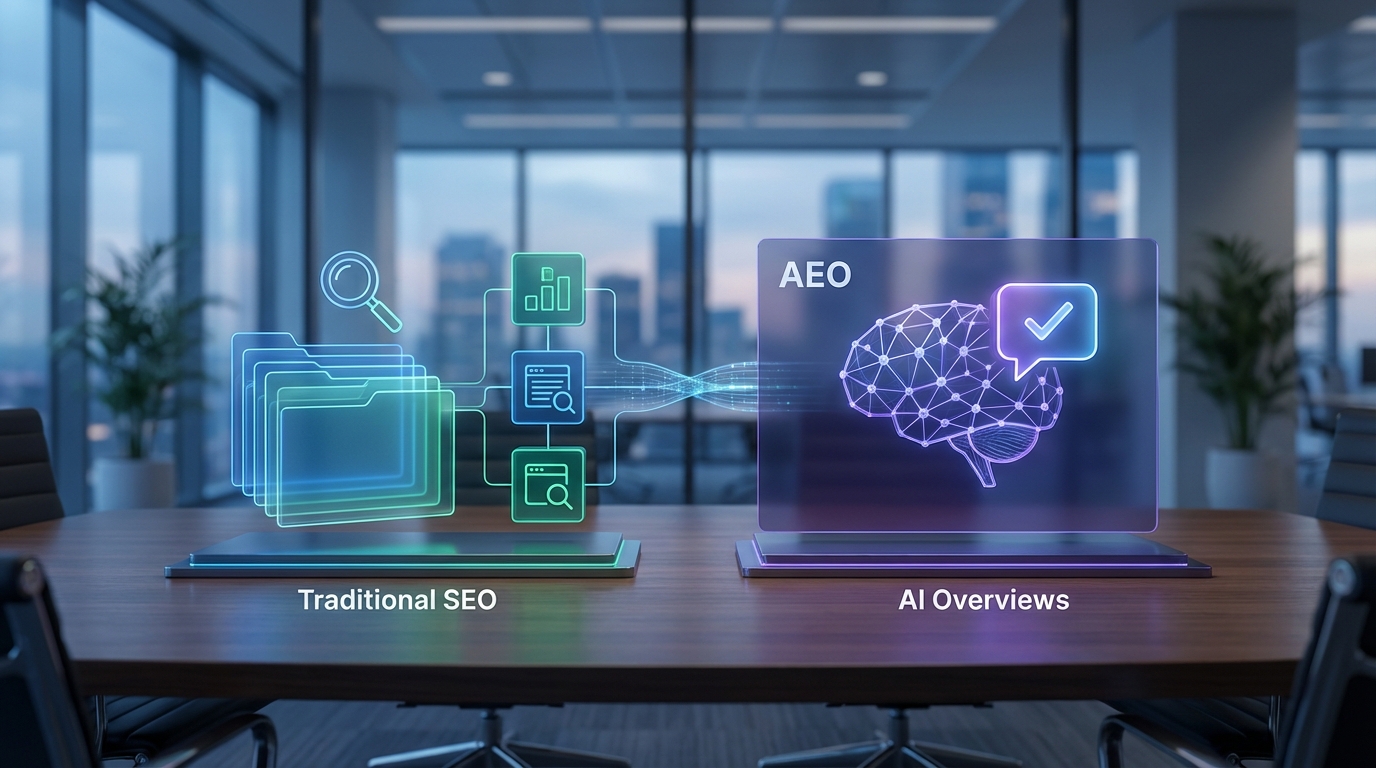
If your strategy is still “rank the page, win the click,” you’re optimizing for a shrinking slice of search.
Answer engines (AI Overviews, featured snippets, and voice assistants) increasingly extract answers instead of sending traffic. As that accelerates, visibility and traffic diverge: you can “win” the SERP and still lose the customer journey if you’re not the source being quoted.
This guide breaks down:
- What changes when search shifts from ranked pages → extracted answers
- A hybrid page structure that supports SEO + AEO
- The signals answer engines tend to rely on when choosing what to summarize or cite
- How to operationalize E‑E‑A‑T when your content may be shown without a click
- A practical rollout plan (with timelines that reflect real teams)
What’s the difference between traditional SEO and AEO?
Traditional SEO is primarily about getting a page to rank and earning the click.
AEO is about making your content easy to lift, summarize, and cite in AI Overviews, snippets, and voice answers—often without a click.
HubSpot captures the core distinction well: AEO prioritizes direct, extractable answers (often high on the page), while SEO emphasizes long-form depth, topical coverage, and broader ranking factors (Answer engine optimization vs. traditional SEO - HubSpot Blog).
How you should measure success (SEO vs. AEO)
- Traditional SEO success: rankings → clicks → sessions → conversions
- AEO success: inclusion/citation → answer visibility → brand trust/recall → downstream conversions
Contractor Growth Network frames AEO as competing to get content quoted or cited by AI systems, not just ranked (Answer Engine Optimization: Our Initial Strategies).
Key takeaway: You’re not choosing SEO or AEO. You’re building pages that can both rank and get extracted.
How do you structure content so answer engines can extract it (without sacrificing SEO depth)?
Answer engines perform best when they can quickly identify:
- The question being answered
- The shortest complete answer
- Supporting proof and detail (steps, caveats, examples)
HubSpot’s guidance consistently points back to the same structural unlock: put a direct answer early, then expand (Answer engine optimization vs. traditional SEO - HubSpot Blog).
The “Answer‑First” hybrid page template (SEO + AEO)
Use this on any page targeting a high-intent query:
- H1 that matches the user task (what they’re trying to do)
- Answer Block (40–80 words) directly under the H1
- Scannable expansion (bullets/steps/table)
- Deep sections for nuance, edge cases, examples, and internal links
- FAQ (only if it adds new coverage)
- Schema markup aligned to intent (FAQPage, HowTo, Article)
What a good Answer Block looks like
Example (definition intent): “What is answer engine optimization?”
Answer engine optimization (AEO) is the practice of structuring content so AI-driven search experiences can extract and present your answer directly (for example in AI Overviews, featured snippets, or voice answers). It typically relies on clear definitions, Q&A formatting, and machine-readable markup.
Keep it:
- Direct: no warm-up paragraph
- Complete: answers the question in one liftable unit
- Grounded: don’t assert what you can’t support later on the page
Which formats get extracted most reliably?
In practice, answer engines most consistently lift:
- Short paragraphs that answer one question
- Numbered steps (process/how-to queries)
- Bulleted lists (criteria, options, pros/cons)
- Tables (comparisons, specs, ranges)
- Q&A blocks (conversational variants)
Before-and-after: what a real AEO restructure looks like
Here’s a realistic example based on what we see in B2B content audits: the original page is “SEO-correct” (keywords, depth) but hard to extract.
Before (hard to extract)
H1: Answer Engine Optimization Guide
Intro paragraph (120+ words): Answer engine optimization is becoming an increasingly important part of modern search marketing as AI continues to evolve. Businesses are starting to see changes in how users interact with search engines, and this shift impacts how content should be created and optimized. In this guide we’ll explore what AEO is, why it matters, and how to implement it across your site…
Problems:
- The definition is buried.
- No single paragraph cleanly answers “what is AEO?”
- The page makes the reader (and the model) work.
After (extractable, still SEO-rich)
H1: What is Answer Engine Optimization (AEO)?
Answer Block (56 words): Answer engine optimization (AEO) is the practice of writing and structuring content so AI search experiences can reuse it as a direct answer—often in AI Overviews, snippets, or voice results. AEO usually means putting a clear answer near the top, supporting it with steps or examples, and adding markup that clarifies page intent.
Then immediately:
- In one sentence: AEO is about getting cited, not just clicked.
- Checklist: what to change on the page (headers-as-questions, Q&A, table, sources)
- Deep sections: “How AEO differs from SEO,” “How to implement schema,” “Common pitfalls,” “Measurement”
Result: A model can lift the definition instantly, and the rest of the page still earns traditional rankings.
What signals do answer engines prioritize (vs. traditional search)?
Traditional search has historically rewarded a blend of crawlability, relevance, and authority proxies (including links).
Answer engines still use many of those inputs—but they add a higher bar: can the system confidently reuse your content as an answer?
Traditional SEO tends to overweight
- Keyword-to-page matching
- Backlinks and authority proxies
- Technical performance and indexability
- SERP engagement signals (varies by engine)
AEO tends to overweight
-
Semantic clarity (entity-first writing)
- Use explicit nouns and definitions.
- Reduce ambiguous “it/this/they” chains.
-
Question alignment (conversational intent)
- Write headings as real questions.
- Answer immediately under the heading.
-
Extractability (structure + formatting)
- Put the best answer high on the page.
- Use lists/tables when they reduce ambiguity.
-
Machine readability (schema + consistent patterns)
- Schema won’t force inclusion, but it can reduce ambiguity.
-
Topical authority (coverage + consistency)
- Not one “perfect article”—a reliable cluster of related answers.
-
Verification signals (citations + provenance)
- Answer engines are risk-averse; they prefer content with clear sourcing.
Contractor Growth Network specifically calls out writing for questions and using schema to improve your odds of being used in AI answers (Answer Engine Optimization: Our Initial Strategies).
How do you scale AEO without publishing unverified AI content?
If you’re using AI to generate drafts, your advantage won’t come from “more pages.” It comes from more defensible pages—content you can stand behind when it’s quoted without context.
In AEO terms, “verified” means:
- Claims are attributable (citations, data, or first-hand methodology)
- Definitions stay consistent across pages (no internal contradictions)
- Recommendations include conditions (who it’s for, when it fails, constraints)
This is also where content operations matter. Whether you call it content marketing automation or simply a disciplined workflow, the mechanism is the same: bake requirements into the process so quality doesn’t depend on heroics.
A lightweight governance system that works
- Required fields in every draft: sources, author, last reviewed date, assumptions/conditions
- Editorial QA checklist: factual verification, entity consistency, internal contradictions, on-page Answer Block present
- Approval rule for statistics: no stat goes live without a primary source link
Bottom line: If you can’t defend a claim in a sales call, don’t publish it in a format that an AI assistant can quote as fact.
How does E‑E‑A‑T change for AEO?
E‑E‑A‑T (Experience, Expertise, Authoritativeness, Trustworthiness) isn’t new. The change is when it’s evaluated.
In traditional SEO, E‑E‑A‑T often accumulates at the site level over time.
In AI search, E‑E‑A‑T becomes more immediate and contextual: the system is deciding whether your page is safe to reuse as an answer.
HubSpot notes that AEO benefits from explicit credibility signals like author bios and citations because the content must stand up as a direct answer (Answer engine optimization vs. traditional SEO - HubSpot Blog).
Practical E‑E‑A‑T upgrades you can ship this sprint
Experience
- Add first-hand steps, constraints, and “what we do in practice” guidance.
- Include a brief “How we know” section for high-stakes topics.
Expertise
- Use bylines and bios that match the topic (role, years in the work).
- Define terms on first use; don’t hide behind jargon.
Authoritativeness
- Build clusters: overview → sub-questions → supporting evidence.
- Link intentionally so you’re not a one-off answer.
Trustworthiness
- Cite sources for key claims.
- Add last updated and reviewed by fields.
- Replace absolutes with conditions (ranges, scenarios, prerequisites).
How do you measure AEO success (without fooling yourself)?
You can’t manage AEO if you only look at sessions. You need a measurement layer that treats visibility without clicks as a first-class outcome.
What to track (core AEO metrics)
- Impressions for question-based queries (trend line)
- Featured snippet presence (ownership rate on priority queries)
- Brand mentions inside AI experiences (where observable)
- Assisted conversions (users who return via branded search, direct, or sales touchpoints after exposure)
- Branded query lift over time (directionally useful even when attribution is imperfect)
Where to get the data (practical tool map)
-
Google Search Console (GSC):
- Use the Performance report to isolate queries that are phrased like questions (“what is…”, “how to…”, “best…”, “vs”).
- Watch impressions and average position for those queries before/after Answer Block rollouts.
- Segment by page to see which templates correlate with improved visibility.
-
SERP spot checks (repeatable, not random):
- Maintain a fixed list of ~25 priority queries.
- Check weekly for: featured snippet presence, “People also ask” coverage, and whether your brand is shown/cited.
-
Rank tracking (useful, but not sufficient):
- Track rankings as a baseline, then annotate changes when you introduce Answer Blocks, schema, and FAQ rewrites.
A simple reporting cadence that works for content teams
- Weekly (30 minutes): visibility movement on the query set; log which pages gained/lost snippet features.
- Monthly (60–90 minutes): tie visibility changes to downstream signals (branded search trend, demo requests influenced, assisted conversions).
Key takeaway: For AEO, impressions without clicks are not “vanity.” They’re distribution.
What’s the rollout plan to move from SEO-only to SEO + AEO?
This is the operational plan you can hand to your team.
Phase 1: Decide what “winning” means (and what you’ll measure)
- Define AEO outcomes you care about: citations/mentions in answer surfaces, snippet ownership, brand recall.
- Update reporting so you’re not blind to zero-click visibility.
Timing guidance:
- For a content team of ~5, budget 3–5 working days to align on definitions, query set, and reporting.
- For an enterprise team (multiple sites/stakeholders), plan 2–4 weeks.
Phase 2: Audit priority pages for extractability
For each page, score these fast:
- Does it answer the primary question in the first 10–15% of content?
- Are H2/H3s written as questions with direct answers underneath?
- Are comparisons/criteria represented as tables or lists?
- Are key claims cited or backed by first-hand experience?
- Is schema appropriate for the intent?
Timing guidance:
- ~25 pages: 1–2 weeks for a small team.
- 200+ pages across multiple categories: 4–8 weeks (and you’ll still want to prioritize ruthlessly).
Phase 3: Rewrite using the hybrid template
- Add an Answer Block to every priority page.
- Convert at least one major section into a list, steps, or table.
- Keep depth—just push it below the answer layer.
- Implement schema where it clearly matches intent.
Phase 4: Build a “question network” per topic
For each cluster, cover:
- Core definition
- How it works
- Pros/cons
- Cost or effort range (with conditions)
- “Best for” scenarios
- Neutral alternatives framing
Interlink so engines and humans see complete coverage.
Phase 5: Governance (so quality survives scale)
- Brand voice rules + claim boundaries
- Verification requirements (especially for stats)
- QA checklist and refresh cadence
What are the most common AEO pitfalls (and the fixes)?
Pitfall 1: Publishing “AEO-only” thin pages
Fix: Lead with an answer, then earn trust with depth and evidence.
Pitfall 2: Treating schema like a magic switch
Fix: Schema clarifies structure; it doesn’t replace clear answers or credibility.
Pitfall 3: Scaling unverified AI content
Fix: Make citations, author review, and consistency checks non-negotiable.
Pitfall 4: Measuring only clicks
Fix: Track impressions on question queries, snippet ownership, and brand lift signals alongside traffic.
Conclusion: the play is “rank + get cited”
Traditional SEO is still necessary. It’s just not sufficient on its own.
If you want to win in AI-driven search, structure your content so it can be confidently extracted as a direct answer—while keeping the depth that earns rankings, trust, and conversions.
Next step: Pick your top 10 revenue-driving pages this week. For each one: add an Answer Block under the H1, rewrite two H2s as questions with direct answers, convert one section into a table or steps, add citations for core claims, and implement the most relevant schema. Then track GSC impressions and snippet presence over the next 30 days.